
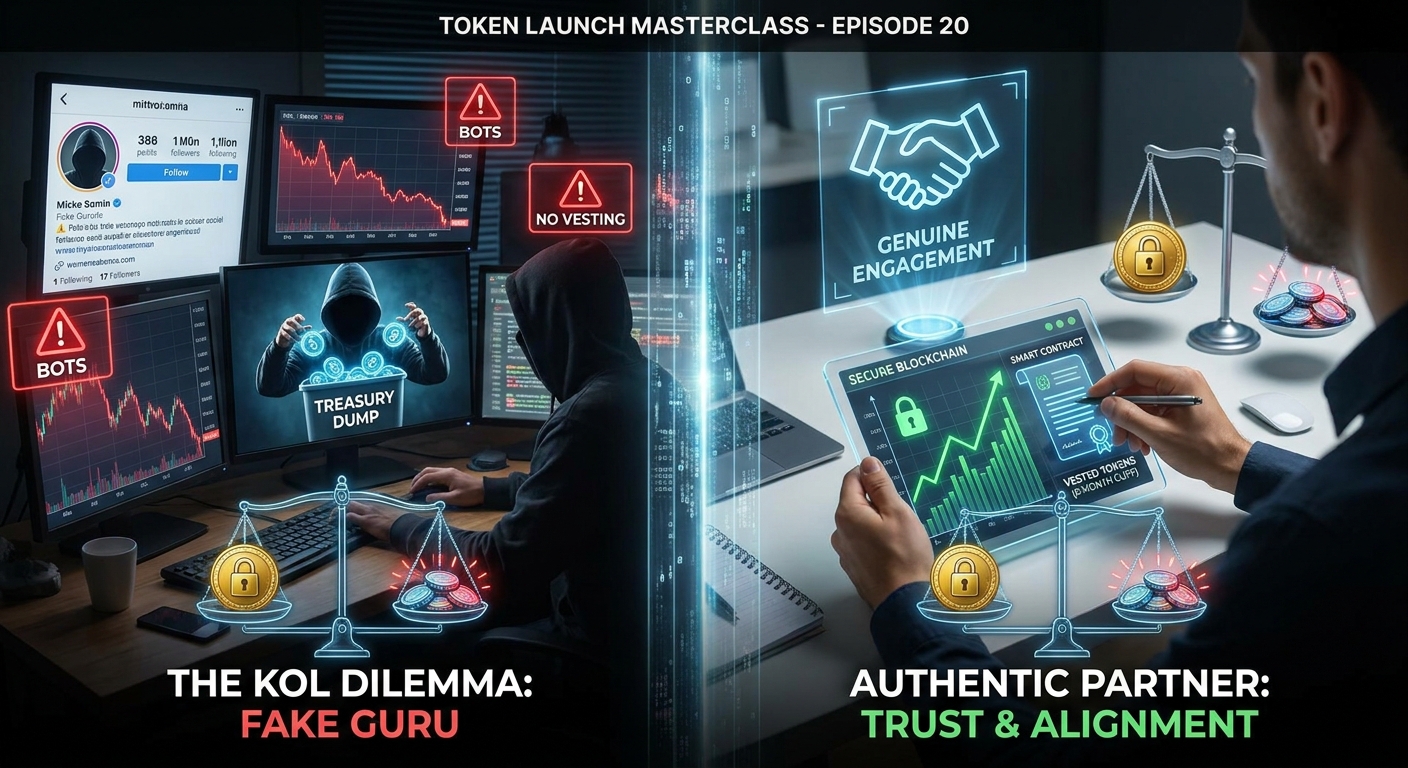
Hello and welcome back to the Token Launch Masterclass!
Today we’re tackling one of the most dangerous minefields in crypto launches: working with Key Opinion Leaders, better known as KOLs or crypto influencers.
Let me paint a vivid picture. Early in my career, I watched a project I was advising completely ignore my warnings and pay a so-called “guru” $100,000 in tokens for a handful of posts. The engagement was fake, the community he “brought” was nonexistent, and he dumped every token the moment they unlocked. The project never recovered.
That painful memory is exactly why we’re calling this episode The KOL Dilemma.
These partnerships are genuine double-edged swords. Get them right and you can borrow real trust, spark authentic conversations, and bring in an engaged early community. Get them wrong and you’re essentially setting your treasury on fire for vanity metrics and a few “GM” comments.
Today I’m giving you my complete practical framework so you build real partnerships instead of accidentally funding someone’s next vacation.
What You’re Actually Buying
If your first answer to “what are we buying?” is “a tweet,” you’ve already lost the game.
You’re not buying a post. You’re buying trust by proxy.
A great KOL is like a brilliant translator. They take your 47-page whitepaper and complex tokenomics and distill them into language their audience actually understands and cares about. I once watched a KOL explain a new privacy protocol’s architecture in a 10-minute video better than the project’s own founder could. That’s the gold standard.
They transfer their credibility to you. They introduce your project to people who trust them. That’s incredibly powerful.
But here’s the catch (and it’s a big one): that trust is incredibly fragile.
If their feed looks like a rotating door of sponsored projects — one every 48 hours — their audience is exhausted. Their endorsement becomes meaningless. And if they ever get tangled in drama or, heaven forbid, promote something that turns out to be a scam, that stench travels straight to your project. Some associations you simply can’t un-ring.
How to Become a Data Detective
Follower count is the most useless metric in crypto. It’s also the easiest to fake.
My process is ruthless and I suggest you make it yours.
First, I run their handle through a reputable audit tool. I want to see suspected bot percentage under 15%. Anything higher and I don’t even bother with the rest of the evaluation.
Then comes the part most people skip: I spend a solid 30 minutes reading their comments. Not the posts — the comments.
Are people asking intelligent questions? Are they engaging with each other? Or is it just an endless sea of “GM,” “To the moon,” and rocket ship emojis?
If the conversation is purely about price, you’re buying mercenaries, not believers. There’s a massive difference.
Finally, I do my homework on their track record. What projects did they promote six months ago? Are any of them still alive? I once discovered an influencer who had promoted three different projects that rugged within weeks of his posts. That’s not bad luck. That’s a business model.
Data over drama. Every single time.
My Non-Negotiable Red Flag Checklist
I have a mental checklist that’s saved me (and my clients) hundreds of thousands of dollars. If a KOL triggers more than one of these, I walk away immediately. No exceptions.
- The numbers feel wrong: A million followers but only 200 likes and 15 generic comments? That’s not an audience, that’s a facade.
- Toxic history: Their feed is a graveyard of rugged projects and failed launches.
- They refuse tracking links: The classic excuse is “it doesn’t feel authentic.” Translation: they don’t want you to see how little impact they actually have.
- All tokens upfront, no vesting: This tells you everything. Zero skin in the game equals guaranteed dump.
- The comment section is pure toxicity: “Wen moon?” and hostility everywhere. That’s the community they’re bringing to your front door.
You want builders, not mercenaries.
The Three Payment Models (And My Strong Preference)
There are three basic ways people structure these deals. Only one of them actually makes sense for serious projects.
1. Straight cash (stablecoins)
Clean and predictable. You pay $5k, you get $5k worth of promotion. The problem? You’ve bought a mercenary. The moment the invoice clears, their incentive to care about your project drops to zero.
2. 100% tokens
This sounds aligned until the market moves. That $20k token allocation can suddenly be worth $200k, and suddenly your “partner” is highly motivated to dump on your actual community.
3. The Hybrid Model (My Default Choice)
This is where I almost always land. A smaller cash payment to respect their time and cover costs, combined with a meaningful token allocation that vests over time.
It says: “We value your work, but we need you to have real skin in the game.”
How to Structure Deals That Force Alignment
Here’s where we move from basic to sophisticated.
Vesting is non-negotiable. My standard is a minimum 6-month cliff followed by 12-month linear vesting. If they push back on this, they’ve just told you their plan. End the conversation immediately.
Tie bonuses to what actually matters. I once structured a deal where the base compensation was modest, but a significant bonus kicked in based on the number of unique wallets from their referral link that actually staked tokens and provided liquidity. The KOL went from promoter to evangelist overnight.
Give them a messaging kit, not a script. Provide the key facts, must-mention features, and a clear “do not say” list for compliance reasons. Then get out of their way. You hired them for their voice and their community’s trust — let them use it.
Measuring What Actually Matters
If a KOL sends you a screenshot of their tweet’s impressions as a final report, you’ve been taken for a ride. Impressions are the ultimate vanity metric.
My unbreakable rule: every single KOL gets a unique tracking link with UTM parameters. No exceptions.
But we don’t stop at clicks.
The real magic happens when you connect off-chain behavior to on-chain results. How many people who clicked their specific link actually connected a wallet? Staked tokens? Provided liquidity?
I’ve seen campaigns where a KOL with 40k highly engaged followers drove three times the real conversions of a “mega-influencer” with 800k fake followers.
That’s the data that tells you who to work with again.
Final Thoughts: Trust Is Everything
If you remember nothing else from this episode, remember this: vet like your treasury depends on it — because it does.
Start with the data. Run the red flag checklist. Structure deals that force long-term alignment through vesting and performance metrics. Anyone who pushes back hard on these terms is telling you exactly who they are.
True influence isn’t about follower count. It’s about the quality of trust a person has built with their community.
Get that right, and you’ve found a genuine partner. Get it wrong, and you’ve hired a very expensive liability.
That wraps up Episode 20 of the Token Launch Masterclass.
Next week we’re changing gears completely for Episode 21: Guerrilla Marketing for Crypto — where we’ll explore high-impact, low-budget tactics that don’t involve paying influencers at all. Some of these ideas are a little crazy. You won’t want to miss it.
In the meantime, I’d love to hear from you. Have you had a nightmare KOL experience? Or have you found one that became a genuine long-term partner? Drop your stories in the comments — I read every single one.
Until next time, stay sharp out there.
Talk soon,
Your Token Launch Mentor