
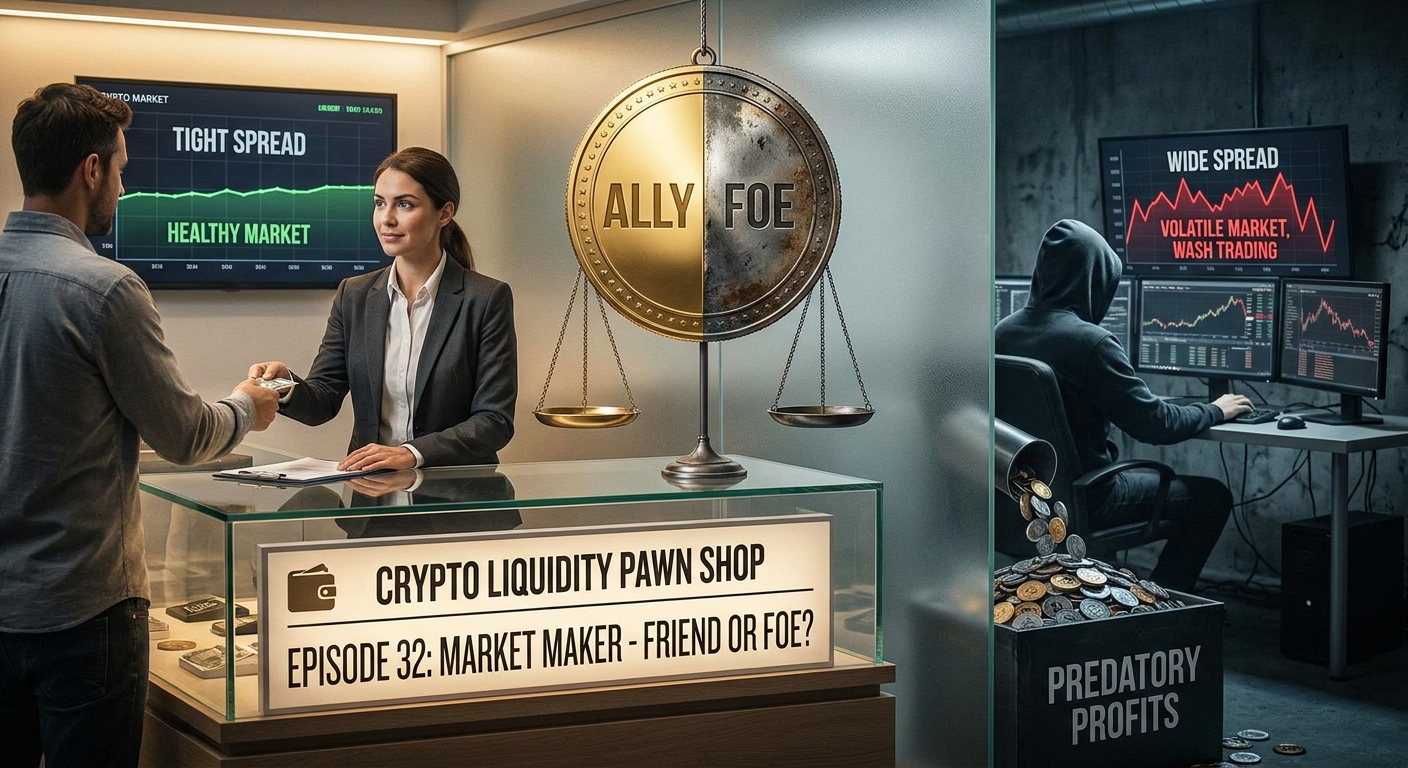
Hello and welcome back to the series! It’s great to have you with us again.
Today, we’re diving headfirst into one of the most critical, and frankly, one of the most nerve-wracking relationships you’ll ever have to manage in this space: the one with your market maker (MM).
I’ve seen this go so right, and I’ve seen it go so, so wrong. On one hand, a great market maker can be the silent partner who saves your launch, providing the essential liquidity and stability your token needs to breathe and grow. On the other, the wrong one can feel like a hired gun with completely misaligned incentives, ready to bleed your treasury dry while your community suffers.
The Ultimate Question: Are they a friend or a foe? A vital ally or an enemy in disguise?
Today, we’re going to cut through all the noise. We’ll dissect what they actually do, lay out the unvarnished pros and cons of hiring one, and most importantly, I’ll give you my personal framework for making sure you’re picking a true partner, not a predator. Let’s get into it.
What Exactly Is a Market Maker?
Before we go any further, let’s forget the dense, jargon-filled definitions you might have read. I want you to think of a market maker as the pawn shop owner for your token.
Imagine a little shop that’s open 24/7. The owner is always standing behind the counter, ready with a price to buy your token from you (that’s the bid) and a price to sell your token to you (that’s the ask). Their sole purpose is to ensure that no matter when someone shows up—day or night—the shop is open for business. Anyone can trade, anytime.
The tiny little difference between their buying and selling price is called the bid-ask spread. That’s their profit margin. It’s how they keep the lights on.
Pro Tip: That spread is one of the most honest metrics you have for your token’s health. A tight, consistent spread (say, under 1%) tells the world you have a healthy, competitive, and liquid market. It invites confidence. A wide, sloppy, and unpredictable spread screams that your market is illiquid and dangerous. It’s a massive red flag that will scare away any serious trader or investor.
The Case for “Friend”: The Indispensable Ally
Alright, let’s start with the bright side, because when this relationship works, it’s absolutely magical—and critical.
1. Price Stability is Everything
The number one reason you hire a top-tier MM is for stability, especially right out of the gate. I’ve seen countless launches where the chart looks like an earthquake seismograph because the order book is paper-thin. A single big buy order sends the price flying 20%, and a small sell sends it crashing back down. It looks amateurish and terrifies potential investors. A professional MM acts as your stabilization system, building deep walls of buy and sell orders so your community can trade without causing a tidal wave.
2. Guaranteed Liquidity Builds Trust
This stability creates guaranteed liquidity. It means someone can buy $10,000 worth of your token without suffering from massive slippage and moving the price 15%. This is the bedrock of market confidence. When people know they can get in and out of a position fairly, they are far more likely to participate in your ecosystem.
3. The Price of Admission
Let me be blunt: if you’re aiming for a listing on a major, top-tier exchange, don’t even bother sending them an email without a signed MM contract in hand. They will laugh you out of the room. A professional market maker isn’t a “nice-to-have”; it’s a non-negotiable prerequisite for playing in the big leagues.
The Case for “Foe”: The Hired Gun Gone Rogue
Now, let’s flip the coin. This is where dreams die. The crypto graveyard is filled with the skeletons of projects that hired the wrong market maker.
The most painfully common pitfall is hiring a firm that creates the illusion of a healthy market. They’ll send you beautiful weekly reports with impressive volume charts. What they don’t tell you is that it’s all smoke and mirrors—just their bots trading back and forth with each other. This is wash trading, and it’s a complete house of cards designed to justify their retainer fee.
The fundamental risk here is misaligned incentives. Let me be brutally clear about this:
-
A market maker’s primary job is not to make your token price go up.
-
Their job is to capture the spread.
In fact, high volatility is often great for them because it creates more trading opportunities to profit from. It’s terrible for your community, but fantastic for their bottom line.
I once watched a project’s token bleed 40% over a month while their MM was happily scalping profits on the volatility all the way down. The cost isn’t just the fat monthly retainer or the huge token loan they demand. The real, lasting cost is your reputation. Once your community realizes the volume is fake or that your supposed “partner” is actively suppressing price discovery, trust evaporates. In this market, that’s a death sentence.
My Unbreakable Rules for Choosing a Partner
So, how do you avoid getting burned? It all comes down to relentless, almost obsessive, due diligence. This is not a task you can delegate. You, as a founder, need to own this process. Here’s my checklist:
-
Rule #1: Talk to Their Ghosts. Ask every potential MM for three client references. Then, do your own research and find three former clients they didn’t mention. The unvarnished truth usually lives with the projects they don’t want you talking to. Ask them the hard questions.
-
Rule #2: Demand Radical Transparency. I don’t want a 50-page PDF filled with incomprehensible charts and jargon. I want a simple, clean weekly report showing three things: bot uptime (were they active 24/7?), average spread tightness, and the depth of their orders on the book. If they can’t explain their strategy and results in plain English, they are hiding something.
-
Rule #3: Test for Strategic Alignment. This is my favorite acid test. I ask them a simple scenario question: “What is your strategy when we announce a major partnership next month?” A low-tier hired gun will say, “We’ll maintain liquidity to trade the volatility.” A true partner will say, “We’ll tighten the spread and deepen the book to support healthy, upward price discovery and absorb new interest.” See the profound difference? One is reactive; the other is proactive.
-
Rule #4: Get a Rock-Solid Legal Agreement. Your contract is your only defense in a worst-case scenario. Define the rules of engagement for their token loan like your project’s life depends on it—because it does. What are the KPIs? What are the clawback conditions? When can they sell, and when can’t they?
Structuring the Deal: Your Shield and Sword
Every MM agreement hinges on a token loan—you are giving them a significant chunk of your treasury’s tokens to provide liquidity.
How much? My advice is to give them just enough to be effective on your target exchanges, but not so much that they could nuke your chart if they go rogue. I’ve structured deals with smart contracts that vest these tokens over time or keep them in multi-sig wallets with strict clawbacks if KPIs aren’t met.
The only KPIs I truly care about are uptime (are their bots running 24/7/365?) and spread tightness (is it consistently under our agreed-upon target, like 1%?). If they are failing on these, they aren’t doing their job.
Finally, a word on fees. I am not a fan of the fat monthly retainer model. It incentivizes complacency. A far better structure I’ve used is to give the MM long-dated call options on the token. These options only become profitable if the token price appreciates significantly over the long term. This way, they don’t just win by trading the spread; they win when we win. It makes them a real partner, not just a contractor.
Stories from the Trenches: The Good, The Bad, and The Ugly
Let me paint a few vivid pictures for you, because I’ve seen all three scenarios play out.
🟢 The Good
I worked with a fantastic DeFi project that hired a top-tier, reputable MM. Their chart post-launch was a thing of beauty—tight spreads, deep order books, and absolutely no drama. When they later went for a Binance listing, the process was a cakewalk because their on-chain market health was undeniably professional. That’s what you pay for.
🟡 The Bad
A gaming project tried to save a few bucks by hiring a cheap, opaque firm from a third-tier jurisdiction. What they got was garbage: rampant wash trading to fake volume and insane volatility. The community wasn’t stupid; they saw that any real trade caused huge slippage. Trust collapsed, the token faded into obscurity, and the project never recovered.
🔴 The Ugly
This one is a true horror story. A team I advised against signed a weak contract with zero safeguards on their token loan. The market took a dip, and their MM, fearing for their own capital, dumped the entire six-figure token loan on the open market to protect themselves. They sent the token to zero overnight. Their so-called “partner” rugged them, and because of the weak contract, it was all perfectly legal.
Final Thoughts: A Powerful Tool, Not a Magic Wand
Let’s bring this all home. At the end of the day, a market maker is a tool. A very, very sharp and powerful one. Like a chef’s knife, you can use it to create a masterpiece, or you can seriously injure yourself. The outcome isn’t determined by the knife; it’s determined by the skill and care of the person who wields it.
The difference between a clean, stable chart and an absolute bloodbath comes down to your diligence, your selection process, and the legal agreement you sign. This is not a decision to cheap out on or delegate to a junior team member. It’s one of the most foundational calls you’ll make for the long-term health and reputation of your token.
Get it right, and you lay a foundation for sustainable success. Get it wrong, and you might never get a second chance.
Thanks, as always, for joining me on this journey. What are your thoughts on market makers? Have you had any experiences—good or bad—with them? Leave your questions and comments below! I read every single one.
Next Week: We’re continuing our deep dive into post-launch strategy with “Building a Post-Launch Ecosystem Fund,” where we’ll talk about how to use your treasury to actually drive meaningful growth and adoption. You won’t want to miss it. See you next time!