
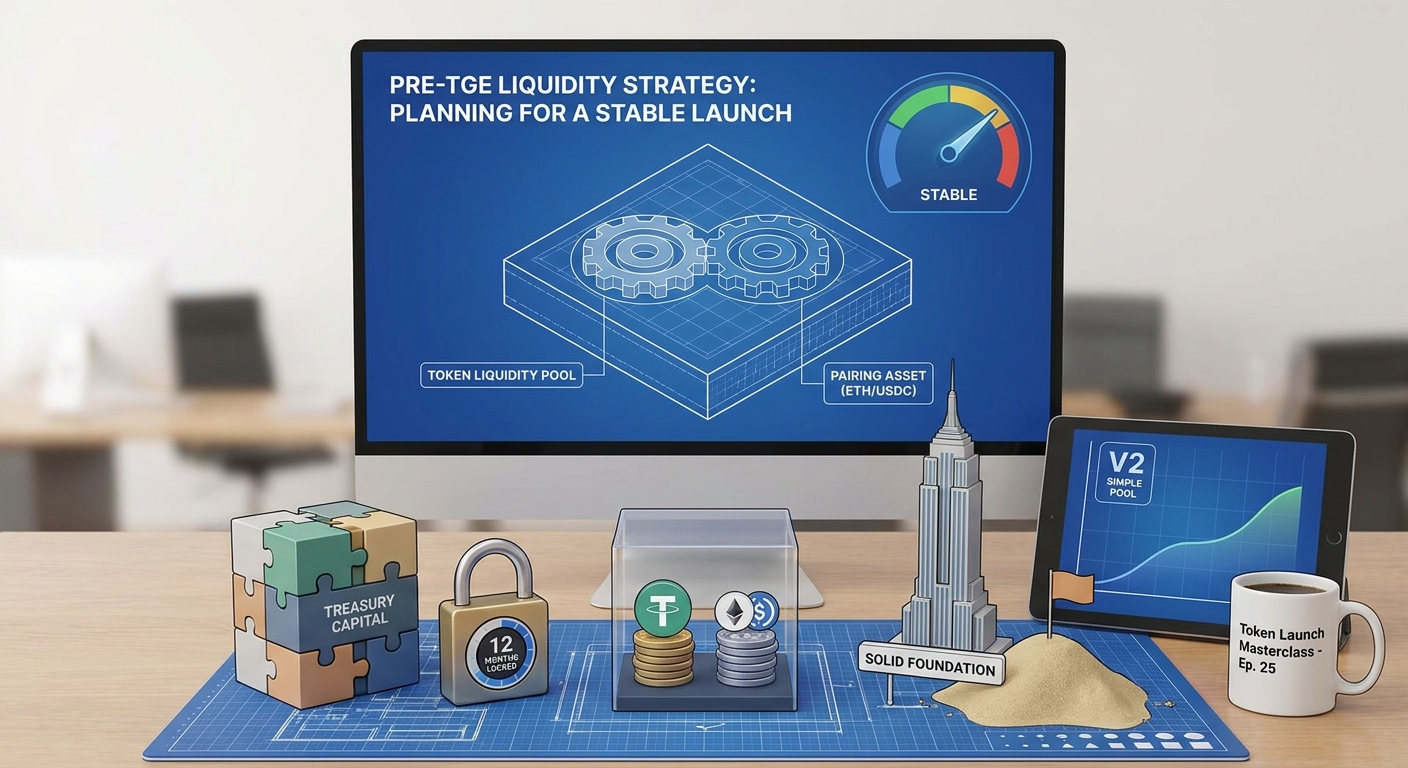
Hello and welcome back to the Token Launch Masterclass!
Today we’re talking about the part most founders secretly dread: liquidity. Not the glamorous marketing campaign or the hype-filled Discord. We’re talking about the actual foundation that determines whether your token survives its first 24 hours or becomes another forgotten casualty on the blockchain.
You can have celebrity endorsements, a whitepaper that reads like poetry, and a community that’s absolutely on fire. But if you botch your initial liquidity, none of it matters. I’ve watched far too many promising projects with massive hype bleed out within hours of TGE because they treated liquidity as an afterthought.
Think of it like this: your token is a new restaurant opening in a busy city. The marketing gets people through the door, but if your kitchen has no ingredients, you’re not opening a restaurant—you’re hosting a very expensive disappointment.
Let’s make sure that doesn’t happen to you.
What TGE Liquidity Actually Is (And Why It Matters)
Strip away the jargon and it’s remarkably simple.
Liquidity is just inventory. It’s the stock on the shelf for your token on a decentralized exchange. When someone wants to buy your token, there needs to be tokens available to buy. When someone wants to sell, there needs to be the paired asset (usually ETH or USDC) available to sell into.
My favorite analogy is the currency exchange booth at an international airport. Imagine that booth is loaded with Euros but only has a tiny stack of Dollars. The first person who walks up with a fat wad of Euros is going to get a terrible rate. That painful price movement you see? That’s slippage.
Your job is to make sure the booth is balanced and well-stocked on both sides from minute one. Good liquidity enables smooth trading, absorbs the initial chaotic volatility of launch, and protects early buyers from getting completely hosed.
This isn’t the sexy part of launching a token. Nobody’s tweeting screenshots of your liquidity pool. But it’s the part that decides whether you’re building a skyscraper or a sandcastle.
Where Does the Money Actually Come From?
There are three main paths, and each comes with its own personality.
Option 1: Your Project Treasury
This is the path I generally prefer for most teams. You raised the money, you control the capital, and you control the LP tokens. There’s something clean about that. The downside is obvious: every dollar sitting in that pool is a dollar you can’t use to pay developers, run marketing, or expand the product. It’s a capital sink.
Option 2: Partner with a Market Maker
They bring the capital so you don’t have to. Sounds great until you realize it’s not charity. You’re trading control for capital, and you’d better make damn sure their incentives line up with your long-term vision. I’ve seen market makers who were perfect partners and others who optimized for their own short-term profit at the project’s expense. Choose very carefully.
Option 3: Liquidity Bootstrapping Pools (like on Fjord)
This is the more sophisticated, transparent route where the market actually discovers the price through a public sale. It can generate incredible community buy-in when done well. The risk? Complexity. If you can’t explain it to your average community member in one sentence, you risk them feeling like something sneaky is happening. Transparency isn’t optional here—it’s survival.
There’s no universally “correct” answer. The right choice depends on your project’s balance sheet, your risk tolerance, and your values.
Where Should You Actually Put This Liquidity?
Don’t overthink the chain. Go where your users actually live. Avalanche project? Trader Joe. Solana? Raydium. Base? Uniswap. Simple.
The more interesting decision is the type of pool.
You’ll primarily face two choices: the classic 50/50 pool (Uniswap V2 style) or the newer concentrated liquidity pools (Uniswap V3).
Let me be blunt with you.
For 95% of launches, I want to see a V2-style 50/50 pool. It’s the “set it and forget it” option. Your liquidity covers every possible price from zero to infinity. It’s simple, robust, and battle-tested.
Concentrated liquidity is incredibly powerful, but for a TGE it’s a loaded gun. I once watched a team get cute with a V3 launch, set their price range too tight, and a single large buy pushed the price completely out of their range. Their liquidity became useless in minutes. The chart looked like it had been hit by a truck.
My unbreakable rule: Eat the capital inefficiency at launch. Choose the simple, predictable V2 model. You can get fancy with V3 later once you have real trading history and breathing room.
How Much Liquidity Is Actually Enough?
This is the question that makes every founder nervous. There’s no magic formula (anyone who tells you there is, is selling something).
I start with a simple question: What slippage is acceptable on a decent-sized trade?
For me, a $10,000 buy shouldn’t move the price more than 2-3%. That’s a healthy market.
My personal rule of thumb: For a project launching with a $1M initial circulating market cap, aim for 10-20% of that in total liquidity. That means $100,000–$200,000 total value in the pool.
This range has been battle-tested across dozens of launches. It provides real stability without completely draining your war chest. Too little and you’re inviting whales to rug your chart. Too much and you’re handcuffing your ability to actually build the project.
The Non-Negotiable: Locking Your Liquidity
This is where the pros separate from the rug pulls.
When you create the pool, the DEX gives you LP tokens—digital receipts proving you own that liquidity. The classic rug pull involves taking those LP tokens and yanking everything out of the pool, leaving holders with worthless tokens.
My advice is non-negotiable: Take those LP tokens and lock them in a public, time-locked smart contract immediately. Use battle-tested platforms like Unicrypt or Team.Finance. I want to see a minimum of 12 months.
Then do the most important part: take that transaction hash and pin it in your main Telegram and Discord.
This single action will kill more FUD than a hundred AMAs combined. You’re not just saying “we’re legit.” You’re showing it in a way the blockchain can verify forever.
The Final Moments Before Launch
This is where theory meets reality.
First, setting the initial price is beautifully straightforward—it’s literally just the ratio of the two assets you add to the pool. One million tokens and 100,000 USDC? You just set your price at $0.10. No dark arts required.
Here’s what I insist on with every project I advise: run the entire sequence on testnet first. No exceptions. I don’t care how good your developer is. Practice like it’s the real thing.
On launch day, overfund the wallet you’re using with native gas tokens. Gas wars are real, and you don’t want to be the team that fails because you ran out of 0.003 ETH.
Finally, timing is everything. The moment you add liquidity, the bots will pounce. The person adding liquidity and the person posting the contract address need to be in perfect sync—down to the second. Any delay simply feeds the snipers.
My Four-Pillar Liquidity Assessment
When I look at any launch plan, I boil it down to four questions:
- Source: Where did the liquidity capital actually come from? Was it strategic?
- Placement: Is it on the right DEX for your community and using the right pool type for stability?
- Math: Show me your calculation for how much is enough. (I want to see the work.)
- Lock: Prove it. Show me the transaction hash.
Nail these four things and you’ve built a foundation most projects never achieve.
Look, liquidity isn’t flashy. It won’t get you retweets or make your community emoji-spam. But it’s the difference between a project that survives its first week and one that becomes another painful lesson in the crypto graveyard.
Do this part right, and everything else becomes so much easier.
That’s it for Episode 25. Next time, in Episode 26, we’re going to talk about the main event itself: TGE Day – A Technical and Communications Checklist for a Flawless Launch. I’ll give you my complete playbook for navigating those chaotic first 24 hours without losing your mind (or your liquidity).
In the meantime, I’d love to hear from you. What’s been your biggest liquidity question or nightmare? Drop it in the comments or hit me up on Twitter.
Until next time, build carefully, lock your liquidity, and I’ll see you in the next episode.
— Your Token Launch Mentor